DIY Skincare for Beginners: Where to Start
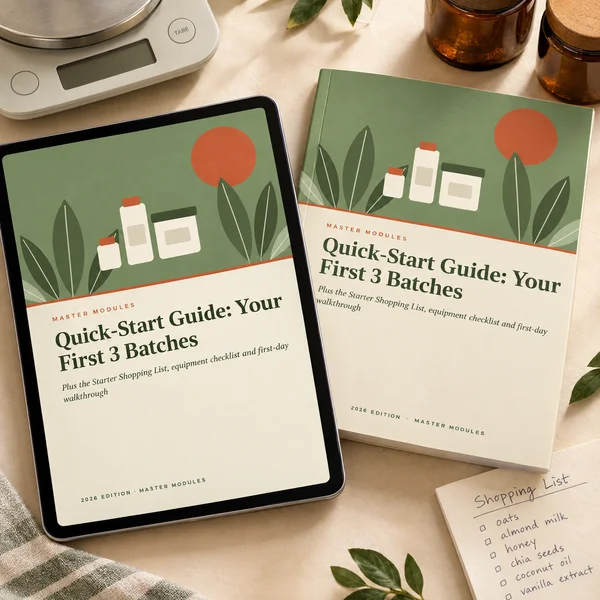
The easiest way into DIY skincare is to learn in the order the ingredients make it hard. Start with products that contain no water, then add water, an emulsifier and a preservative once the basics are second nature. Skipping ahead to a lotion on day one is where most first-time batches go wrong. This guide gives you the order, the equipment and the habits that matter.
The principle: water-free first, emulsions second
| Stage | What you make | New skill | Needs a preservative? |
|---|---|---|---|
| 1 | A balm or lip balm | Weighing in grams, melting, cooling, pouring | No (no water) |
| 2 | A whipped body butter | Controlled cooling, whipping, avoiding grain | No (no water) |
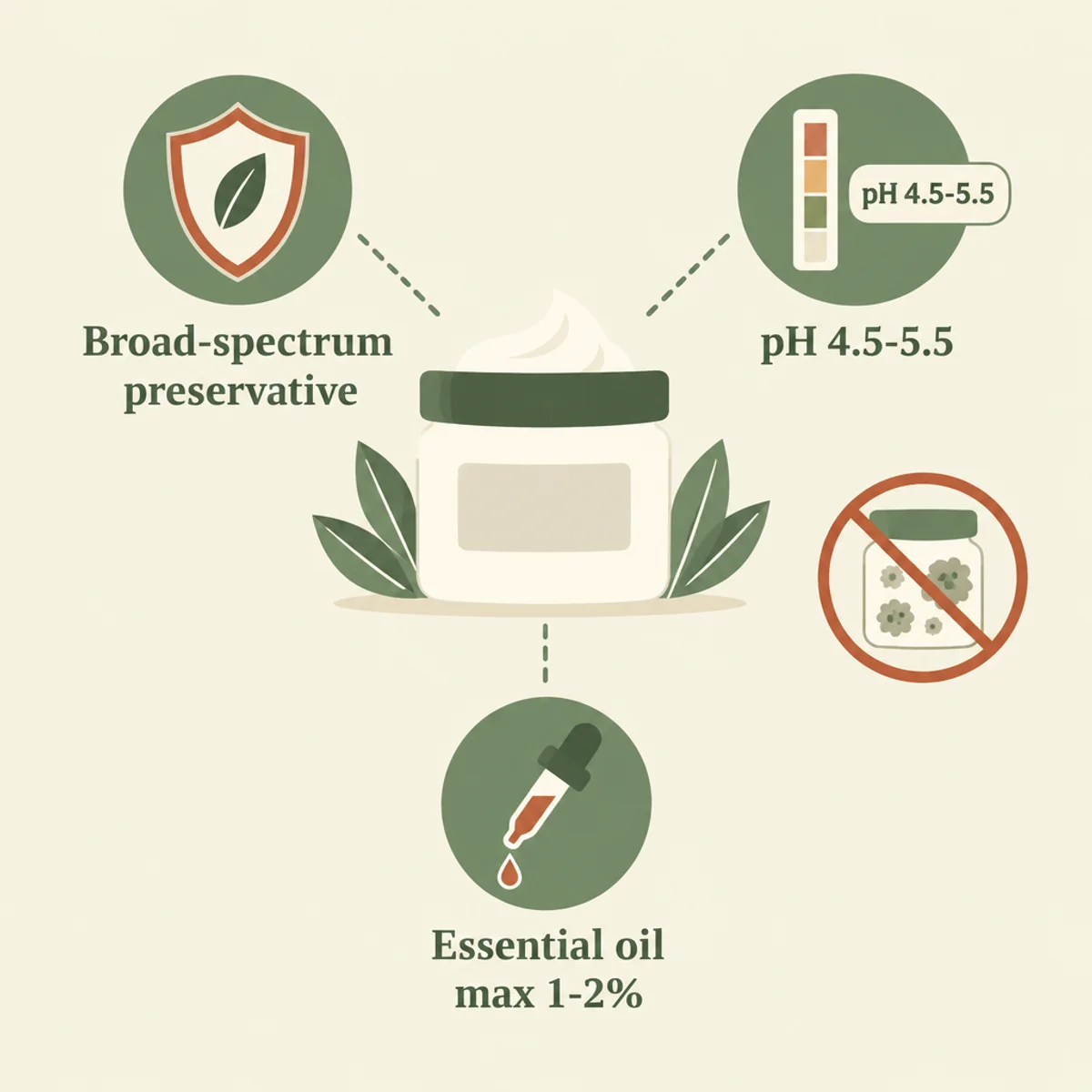
| 3 | A body lotion | Two heated phases, emulsifying, preservative in cool-down, pH check | Yes, broad-spectrum |
This is the same order the Quick-Start guide in The Natural Skincare Formulary uses for its first three batches: Soft Body Balm (or a Classic Beeswax Lip Balm as a mini-batch), Silky Whipped Body Butter and Everyday Body Lotion. The first two have no water, so they are the most forgiving.
What you need to start
You can begin with a pot, a bowl and a kitchen scale. These are the items most makers end up using:
- A digital scale reading to 0.01 g, for preservatives and essential oils.
- Heat-safe glass jugs of 250 and 500 ml, and a saucepan for a water bath.
- A digital thermometer that reads up to 100 °C / 212 °F.
- Small silicone spatulas, a mini whisk, and a handheld frother or stick blender.
- pH strips (range 4 to 7), needed from your first emulsion.
- Clean jars, tins, tubes and pump bottles.
- 70 % isopropyl alcohol spray, paper towels, nitrile gloves and a hair net.
- Labels and a notebook for a batch log.
Keep skincare tools separate from food tools, so oil and fragrance residues do not cross over.
Weigh in grams, think in percentages
Formulators work in weight, not volume. A tablespoon of shea butter and a tablespoon of jojoba oil weigh different amounts, and cups vary from kitchen to kitchen. A formula written in percentages always totals 100, and grams equal percentage times batch size divided by 100. A 100 g batch means 1 % is 1 g. To make 250 g of the Silky Whipped Body Butter, 42 % shea butter becomes 42 × 250 ÷ 100 = 105 g.
Hygiene is most of the job
Cleanliness is the biggest reason homemade products last, or do not. A simple routine:
- Wash everything in hot soapy water and rinse well.
- Spray or wipe with 70 % isopropyl alcohol and let it air-dry fully.
- Sanitise jars and lids, spatulas, beakers, the thermometer probe and your scale surface.
- Wear clean gloves, tie your hair back and never dip fingers into the finished product.
- Use distilled water for anything water-based. Tap water carries minerals and microbes.
Your first batch, in outline
- Pick a 100 g balm formula and write each ingredient weight in grams before you start.
- Weigh the hardest ingredients first (wax, then butters), then the liquid oils.
- Melt in a water bath until clear, then take off the heat.
- Stir in vitamin E and any optional essential oil once it has cooled a little.
- Pour into clean, dry containers and leave them uncapped until set.
- Label with the name, date and batch number, and log what you did.
A starter ingredient list in the Quick-Start guide has 15 ingredients chosen to unlock as many formulas as possible, from shea butter and sweet almond oil to emulsifying wax NF and a broad-spectrum preservative.
When you are ready for a lotion
Read the preservatives and pH chapters first. An emulsion needs the oil and water phases at the same temperature, a few minutes of blending, a preservative added in the cool-down phase and a pH check. How to make lotion walks through the full method, and preservatives for homemade skincare explains why water always needs one.
Common first-timer mistakes
| Mistake | Better approach |
|---|---|
| Measuring in cups or tablespoons | Weigh everything in grams |
| Skipping the sanitising step | Wipe tools, jars and surfaces with 70 % alcohol every time |
| Adding essential oils at full heat | Stir them in below 45 °C, within the recipe limit |
| Using too much essential oil | Stay within the limit for each product type |
| Capping jars while still warm | Cool uncovered so condensation does not form inside the lid |
| Cooling shea butter too slowly | Chill briefly and whip so crystals stay small |
| No label or batch log | Write the date, recipe and any changes, every batch |
| Changing three things at once | Change one variable per batch |
| Making a big first batch | Start at 100 g so mistakes cost little |
Safety basics
- Patch test every finished product on your inner forearm for 24 hours before regular use.
- Do not use a product on broken or irritated skin, and stop if irritation appears.
- Keep products away from the eyes.
- Essential oils are optional. Stay within the maximums in the essential oil dilution chart.
- This is educational content, and it is not medical advice.
Where to go from here
Try the whipped body butter recipe for batch two, and the lip balm recipe if you want a quick mini-batch for batch one.
What the book gives you
The Natural Skincare Formulary is built for this order. Of its 60 formulas, 39 are rated Beginner, and the equipment, hygiene, measuring, phases, pH, preservatives and essential oil safety chapters come before the recipes. The Quick-Start guide, a Troubleshooting Field Guide with 47 problems and a 150-swap substitution sheet are included as bonuses.