Essential Oil Dilution Chart for Homemade Skincare
Essential oils are concentrated, so the amount in a skincare product is capped by the type of product. The chart below gives the maximum total essential oil for each kind of product, then turns the percentages into grams for common batch sizes. These figures are the conservative general guidelines used in The Natural Skincare Formulary, drawn from published references such as Tisserand and Young's Essential Oil Safety and IFRA standards. They are a starting point and not a substitute for the safety data on your specific oil.
The chart: maximum total essential oil by product type
| Product type | Typical maximum total essential oil |
|---|---|
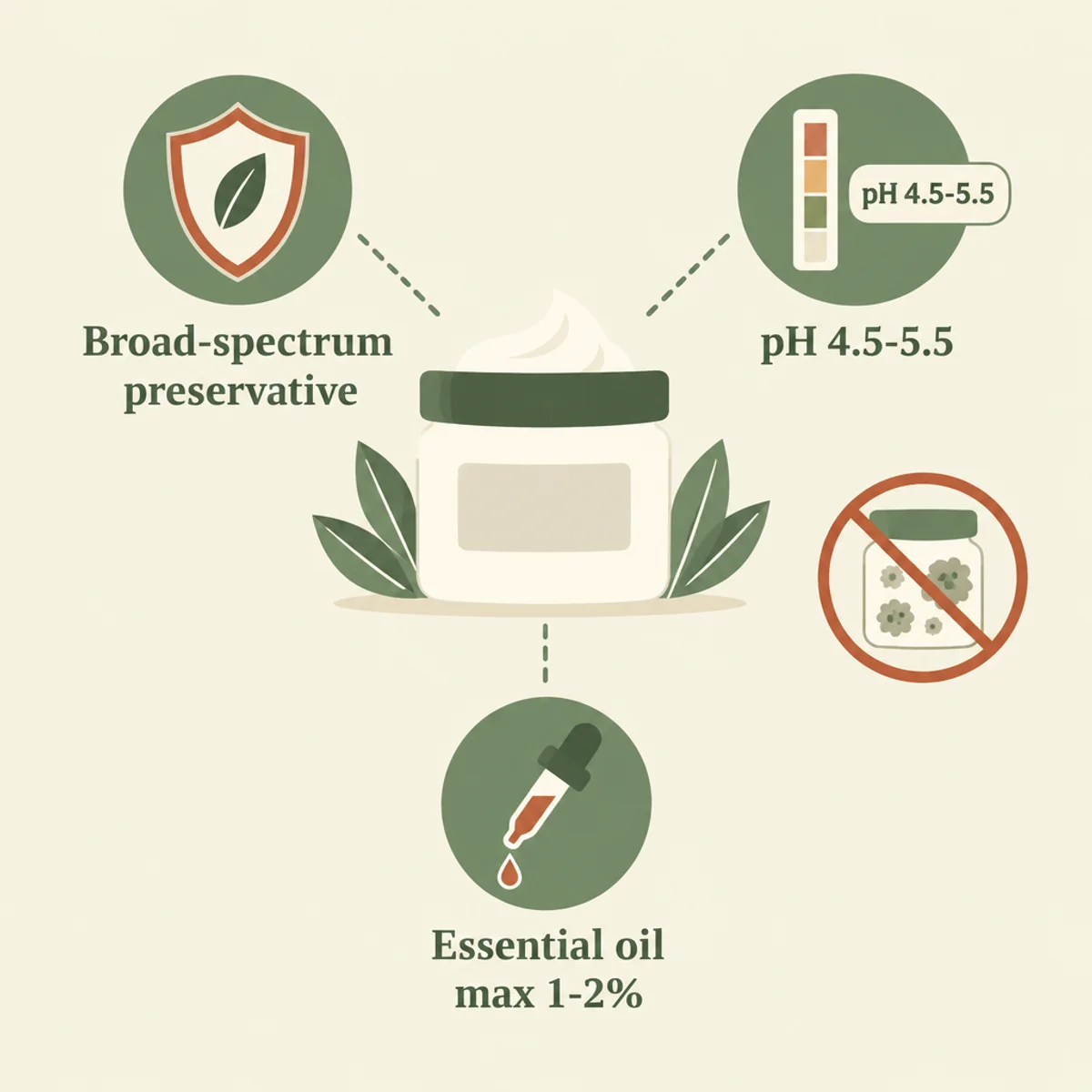
| Face leave-on (serums, creams, toners) | 0.5 to 1 % |
| Body leave-on (lotions, butters, balms) | 1 to 2 % |
| Rinse-off (scrubs, cleansers, bath products) | 2 to 3 % |
| Lip products | 0.5 % |
| Children, babies, pregnancy, nursing | Avoid, or ask a qualified professional |
Two further points from the book: the percentage is the sum of all essential oils in the product, not each one alone, and essential oils are optional in every formula. Every recipe works without fragrance.
Percentages in grams
Grams = percentage × batch size ÷ 100. Weigh essential oils on a scale that reads to 0.01 g, because counting drops makes blends drift from batch to batch.
| Product | Max % | In 50 g | In 100 g | In 250 g |
|---|---|---|---|---|
| Face leave-on | 1 | 0.5 g | 1 g | 2.5 g |
| Face leave-on (lower) | 0.5 | 0.25 g | 0.5 g | 1.25 g |
| Body leave-on | 2 | 1 g | 2 g | 5 g |
| Body leave-on (lower) | 1 | 0.5 g | 1 g | 2.5 g |
| Rinse-off | 3 | 1.5 g | 3 g | 7.5 g |
| Lip balm | 0.5 | 0.25 g | 0.5 g | 1.25 g |
If your scale cannot read to 0.01 g, make a bigger batch, or use a dilution of your essential oil in a carrier oil.
What the recipes actually use
| Formula | Product type | Essential oil in the formula |
|---|---|---|
| Silky Whipped Body Butter | Body leave-on | 1 % lavender (optional) |
| Classic Beeswax Lip Balm | Lip | 0.5 % peppermint (optional) |
| Soft Sugar Body Scrub | Rinse-off | 1 % sweet orange (optional) |
| Classic Fizzy Bath Bomb | Bath | 1 % sweet orange (optional) |
| Natural Solid Perfume | Small-area perfume | 3 % total, for small areas of skin only |
The perfume figure is higher because a solid perfume is applied to small spots, not the whole body. Do not use these blends on the face. See the solid perfume recipe.
Oils that react with sunlight
Cold-pressed bergamot, lemon, lime and grapefruit can cause skin reactions after sun or UV exposure. For leave-on products use steam-distilled or furocoumarin-free versions, or stay well below published limits, and tell the user about sun exposure. In the formulary's ingredient guide, bergamot is listed at 0.1 to 0.5 % with a reminder to use a furocoumarin-free version in leave-on products.
Other rules from the safety chapter
- Choose reputable suppliers that list the botanical name and batch.
- Avoid essential oils in products for babies and children, and when pregnant or nursing, unless a qualified professional advises otherwise.
- Pets can be very sensitive to essential oils. Keep products and diffusers away from animals.
- Peppermint and other menthol-rich oils should not be used on or near the face of young children.
- Keep essential oils away from eyes and mucous membranes, and do not use them neat.
- A patch test is mandatory for anyone with sensitive or reactive skin.
- Natural does not mean safe. If you are unsure about an oil, leave it out.
How to patch test
- Apply a small amount of the finished product to your inner forearm.
- Wait 24 hours.
- Do not use it if there is any irritation, and stop using it if irritation appears later.
Where to add them
Essential oils go in the cool-down phase, below about 40 to 45 °C / 104 to 113 °F, because heat makes the scent fade. In a scrub or balm, stir them in once the oil mix has cooled to just warm. For the full method, see the lip balm recipe, the sugar scrub recipe and the bath bomb recipe.
What is in the book
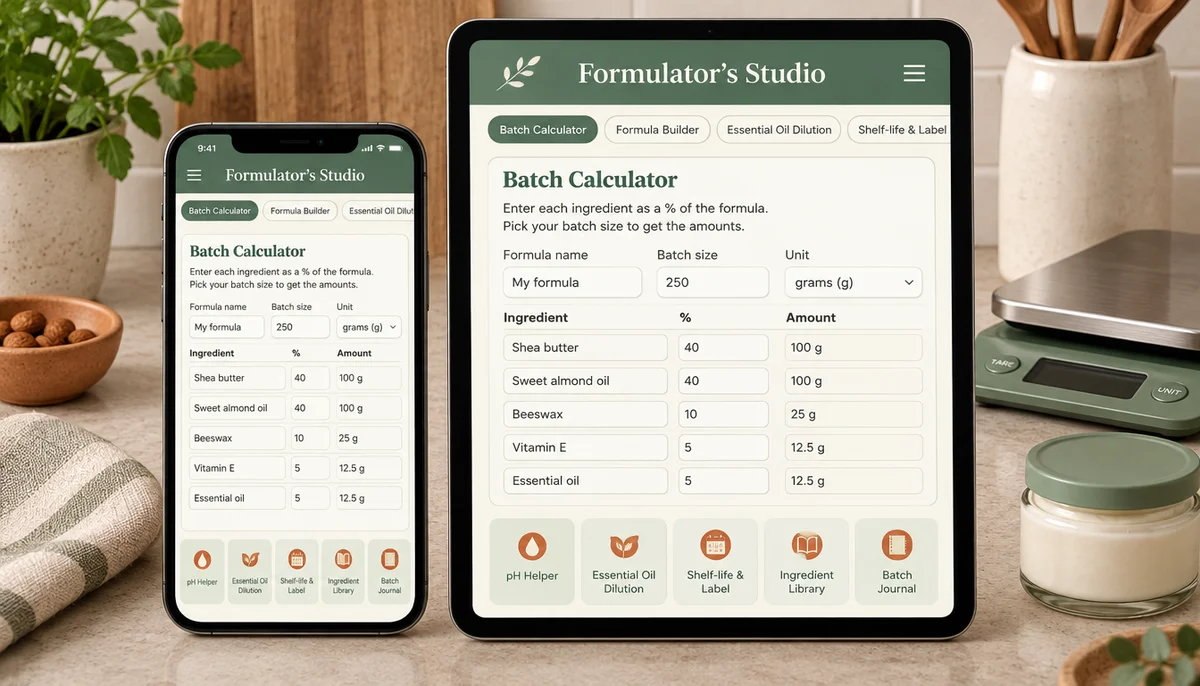
The essential oil safety chapter in The Natural Skincare Formulary holds the chart above, plus the rules on phototoxic oils, pets and children. Each of the 60 formulas notes its own essential oil limit, and the Formulator's Studio web app includes an essential oil dilution tool. A bonus booklet of 12 solid perfume and roll-on blends keeps each one at or below 3 % total essential oil.