Preservatives for Homemade Skincare: When You Need One
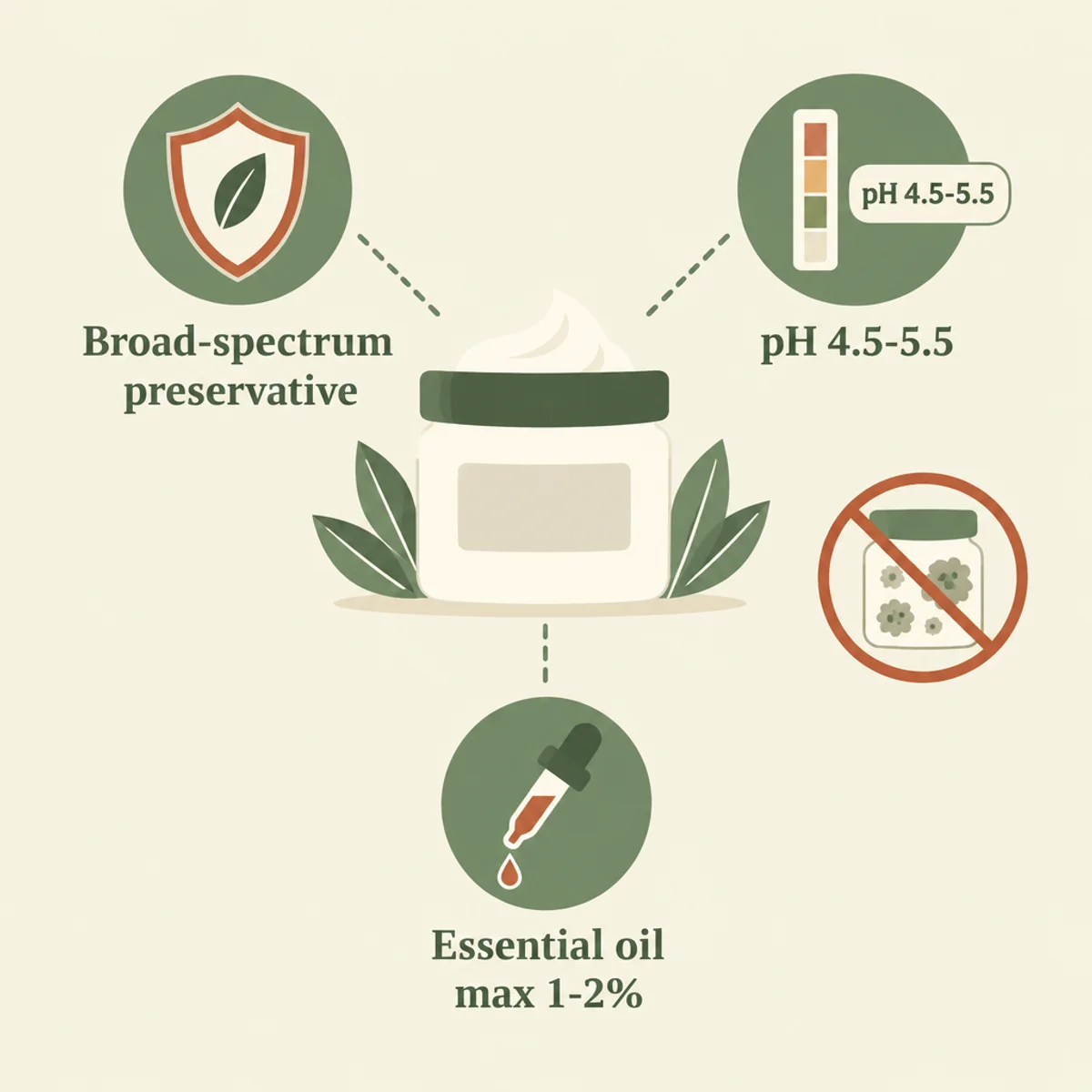
If a product contains water, it needs a preservative. If it has none, it generally does not. That one rule answers most of the questions people search for, including "what is the safest natural preservative." The rest is knowing which ones exist, how much to use, what pH they need and what they cannot do.
When you need one
| Your product | Preservative? | Why |
|---|---|---|
| Lotion or cream (oil and water) | Yes, broad-spectrum | Water supports bacteria, yeast and mould |
| Toner, mist or gel made with water, aloe or a hydrosol | Yes, broad-spectrum | Same reason, and these spoil within days without one |
| Anything with juice, honey or plant extracts in a water base | Yes | These are food for microbes |
| Balm, body butter, lip balm, lotion bar, oil serum, body oil | No water-type preservative | There is no water |
| Dry powders such as clay masks | Not for the dry blend | Mix fresh each time and discard the leftover paste |
The formulary states the rule as: no water, no preservative needed. Water, always preserved. A water-free product still benefits from an antioxidant to slow rancidity, and bath products used in wet conditions need dry scoops and dry storage.
The preservatives in the book
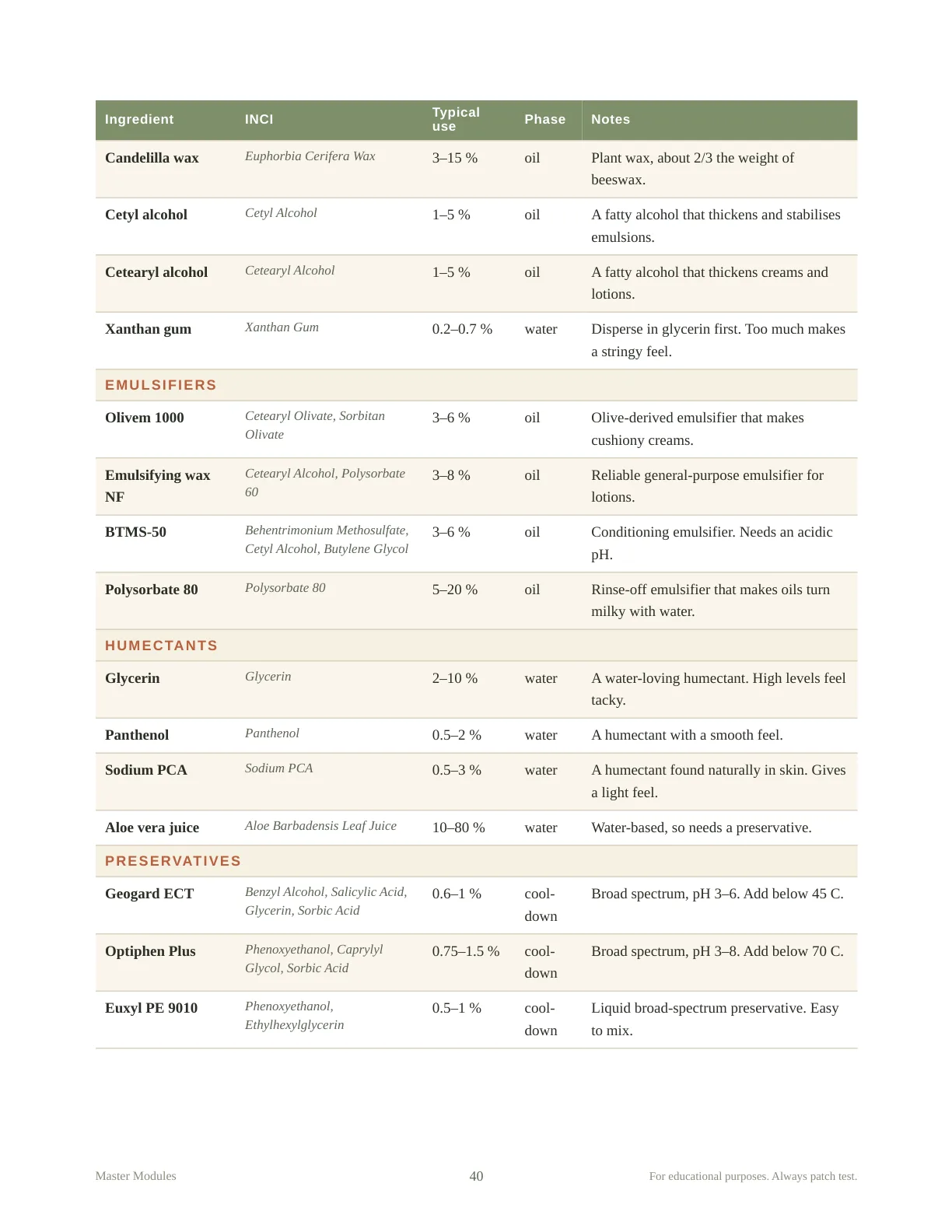
The ranges below are general references. They always yield to the supplier's current data sheet for your exact lot.
| Product | INCI | Typical use rate | pH range | Notes |
|---|---|---|---|---|
| Geogard ECT | Benzyl Alcohol, Salicylic Acid, Glycerin, Sorbic Acid | 0.6 to 1 % | About 3 to 6 | Broad spectrum, added in cool-down below 45 °C / 113 °F |
| Optiphen Plus | Phenoxyethanol, Caprylyl Glycol, Sorbic Acid | 0.75 to 1.5 % | About 3 to 8 | Wide pH range, easy to use in creams and lotions |
| Euxyl PE 9010 | Phenoxyethanol, Ethylhexylglycerin | 0.5 to 1 % | Roughly 3 to 10 | Liquid, easy to disperse |
| Leucidal Liquid | Lactobacillus Ferment | Per supplier data sheet | Per supplier | A boosting ingredient that supports a preservative system. It is not a stand-alone broad-spectrum preservative |
| Vitamin E | Tocopherol | 0.2 to 1 % | n/a | An antioxidant for oils. It is not a preservative against bacteria or mould |
In the formulary's recipes, Geogard ECT is used at 1 % in face creams and toners, Optiphen Plus at 1 % in the Everyday Body Lotion and Euxyl PE 9010 at 1 % in the Rich Hand Cream.
How to use one correctly
- Weigh it to 0.01 g. A 1 % dose in a 100 g batch is 1 g.
- Add it in the cool-down phase, once the batch is below the preservative's limit (Geogard ECT below 45 °C / 113 °F; the formulary's lotions cool to 40 °C / 104 °F).
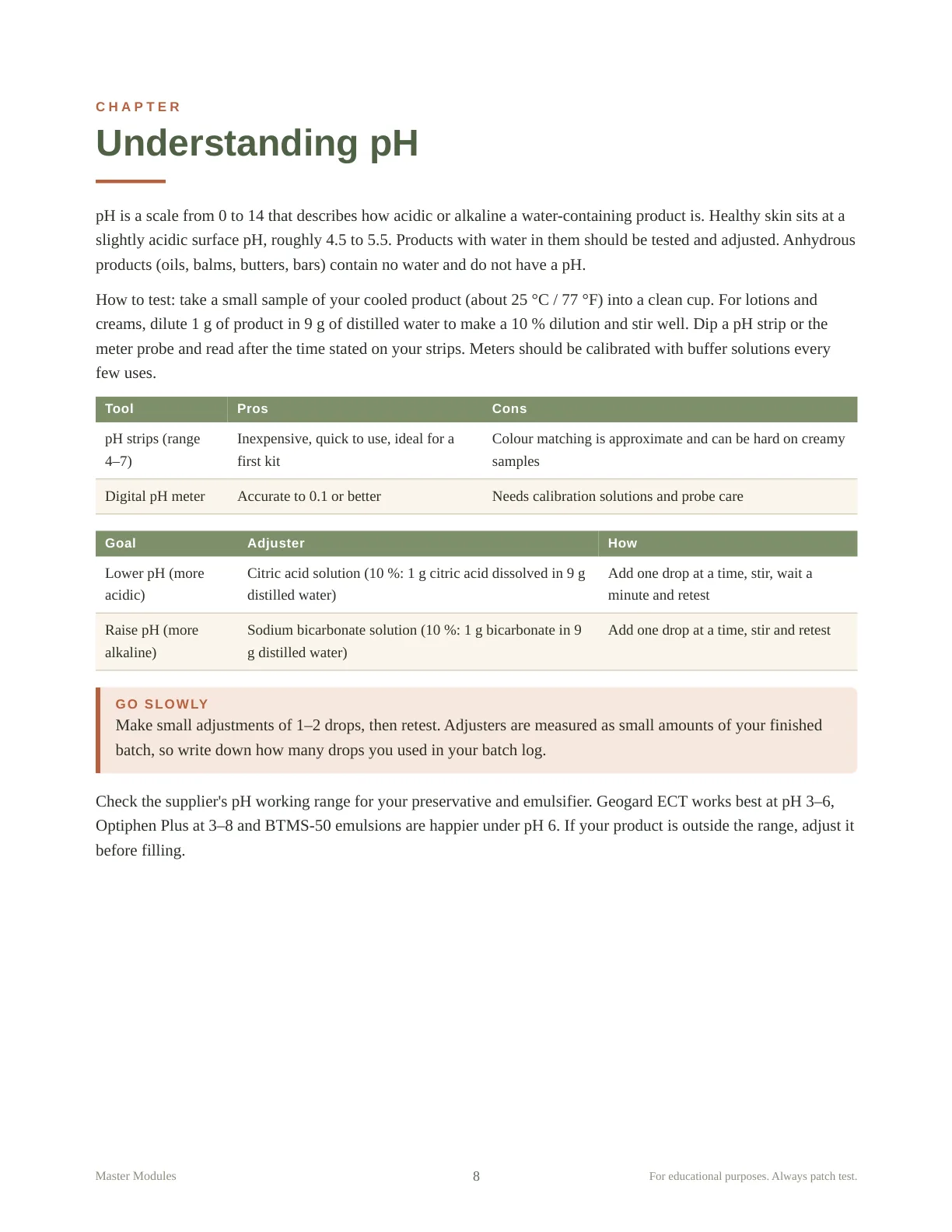
- Check the pH. Test a 10 % dilution of the finished product, and adjust with a drop of 10 % citric acid solution to lower it, or 10 % sodium bicarbonate solution to raise it.
- Use distilled water and clean tools. They are part of preservation.
- Make small batches and use them within the shelf life given.
- Throw away anything that smells off, looks cloudy, changes colour or shows spots, even before its date.
For the full method, see how to make lotion.
What preservatives cannot do
A preservative is not a substitute for hygiene. The formulary's wording is that preservatives are there to protect a clean product, not to rescue a dirty one. They do not make a recipe safe if the rate is below the supplier's range, if the pH is outside the working window or if fingers go into the jar every day. This site cannot promise that any homemade product is safe. It can describe the process, and that process is what you control.
Is there a safest natural preservative?
People often search for the safest natural choice. The answer in the formulary is more modest: natural-sounding does not mean self-preserving. Ingredients like honey, plant extracts and hydrosols are food for microbes. A preservative that is described as natural-friendly on a supplier's site still has to be used at its stated rate and pH, and some, like Leucidal Liquid, are boosters that need a partner. Read the data sheet, note the rate and the pH range, and work from there.
Match the preservative to the emulsifier
The emulsifier also has a pH window, and BTMS-50 emulsions are happier under pH 6. That narrows the choice of preservative and the range you aim for. The table in emulsifying wax NF vs BTMS-50 vs Olivem 1000 shows each one's pH.
How long will it last?
With a preservative, a clean process and a suitable container, the formulary gives emulsions 3 to 6 months, and aqueous products such as toners 1 to 3 months. How long homemade skincare lasts lists the figures by product type.
If you are new to this
Start with products that do not need a preservative, and only add water-based formulas once the weighing, cleaning and cooling routine feels natural. DIY skincare for beginners lays out a three-batch plan that does exactly that.
Where the formulas live
The Natural Skincare Formulary lists the preservative, rate and target pH for each water-based formula, and it has a Preservatives chapter, an Understanding pH chapter and a Hygiene and Sanitising chapter. It also includes a 46-ingredient guide where each preservative has its own entry.