Natural Skincare Ingredients: 46 Grouped by What They Do
Every skincare formula is built from a few groups of ingredients, and knowing what each group does makes recipes much easier to read. Below are 46 ingredients used to make products at home, sorted into ten groups, with the INCI (international) name, the typical use rate, the phase in which it is added and a short handling note. Percentages are shares of the finished batch, and a formula always totals 100.
How to read the tables
- Typical use is the range given in the ingredient guide of The Natural Skincare Formulary. It is a range for formulating, not a recommendation to use that much of any one thing.
- Phase tells you when the ingredient goes in: oil (heated with the oils and butters), water (heated with the water) or cool-down (added below about 40 to 45 °C / 104 to 113 °F).
- INCI is the name to look for when you shop and the one to put on a label.
- For anything that goes in at a fraction of a percent, weigh to 0.01 g.
The ten groups
Butters (3)
Solid fats that give a formula body and a rich feel.
| Ingredient | INCI | Typical use | Phase | Note |
|---|---|---|---|---|
| Shea butter | Butyrospermum Parkii Butter | 5 to 40 % | oil | Rich, creamy and slightly nutty. Can turn grainy if it cools slowly. |
| Cocoa butter | Theobroma Cacao Seed Butter | 5 to 50 % | oil | Hard, brittle and aromatic. Gives firmness to bars and balms. |
| Mango butter | Mangifera Indica Seed Butter | 5 to 30 % | oil | Softer, less scented butter with a smooth glide. |
Oils (12)
The liquid part of the oil phase. Shelf life varies a lot between them.
| Ingredient | INCI | Typical use | Phase | Note |
|---|---|---|---|---|
| Sweet almond oil | Prunus Amygdalus Dulcis Oil | 5 to 40 % | oil | A medium-weight, versatile oil. Avoid if you have nut allergy. |
| Jojoba oil | Simmondsia Chinensis Seed Oil | 5 to 50 % | oil | A stable liquid wax with a light, silky feel and a long shelf life. |
| Sunflower oil | Helianthus Annuus Seed Oil | 5 to 60 % | oil | Light, inexpensive carrier oil with a short-to-medium shelf life. |
| Squalane | Squalane | 5 to 50 % | oil | Very light, stable and almost odourless emollient, often from olives or sugarcane. |
| Rosehip seed oil | Rosa Canina Fruit Oil | 5 to 20 % | oil | A dry oil that oxidises quickly. Store cool. |
| Hemp seed oil | Cannabis Sativa Seed Oil | 5 to 20 % | oil | A dry, green oil that oxidises quickly. |
| Grapeseed oil | Vitis Vinifera Seed Oil | 5 to 30 % | oil | Very light and fast-absorbing. Short shelf life. |
| Camellia seed oil | Camellia Oleifera Seed Oil | 5 to 40 % | oil | Light, stable and silky. |
| Avocado oil | Persea Gratissima Oil | 5 to 15 % | oil | A rich, heavier oil with a green tint. |
| Castor oil | Ricinus Communis Seed Oil | 5 to 25 % | oil | Thick, glossy and sticky. Adds gloss to lip products. |
| Coconut oil | Cocos Nucifera Oil | 5 to 40 % | oil | Solid at room temperature. Melts on skin. |
| Caprylic/capric triglyceride | Caprylic/Capric Triglyceride | 3 to 25 % | oil | Light, silky, very stable emollient, often called fractionated coconut oil. |
Thickeners (5)
Waxes, fatty alcohols and gums that set the firmness of a balm or the thickness of a cream.
| Ingredient | INCI | Typical use | Phase | Note |
|---|---|---|---|---|
| Beeswax | Cera Alba | 5 to 30 % | oil | Structure and body. Not vegan. |
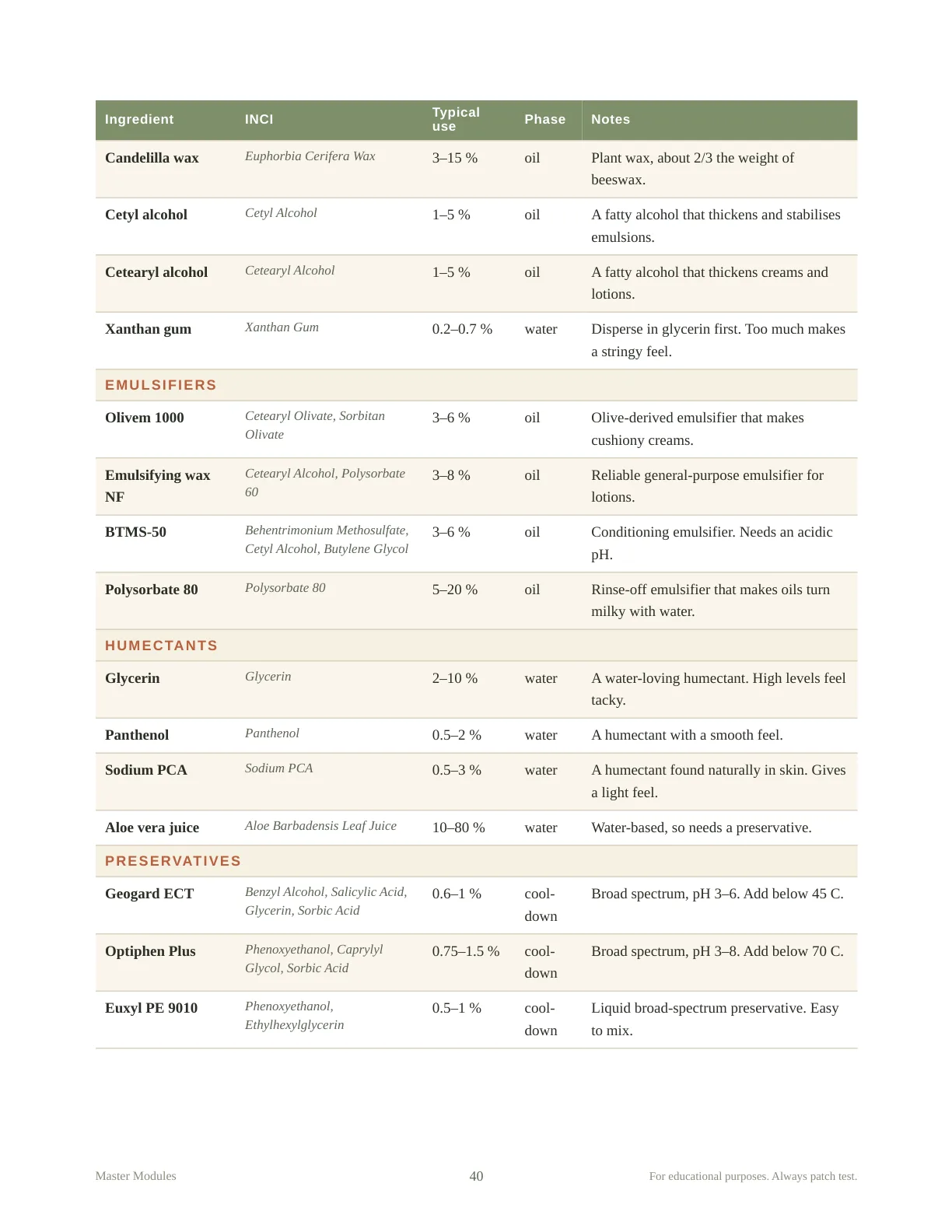
| Candelilla wax | Euphorbia Cerifera Wax | 3 to 15 % | oil | Plant wax, about 2/3 the weight of beeswax. |
| Cetyl alcohol | Cetyl Alcohol | 1 to 5 % | oil | A fatty alcohol that thickens and stabilises emulsions. |
| Cetearyl alcohol | Cetearyl Alcohol | 1 to 5 % | oil | A fatty alcohol that thickens creams and lotions. |
| Xanthan gum | Xanthan Gum | 0.2 to 0.7 % | water | Disperse in glycerin first. Too much makes a stringy feel. |
Emulsifiers (4)
These hold oil and water together in lotions, creams and rinse-off products.
| Ingredient | INCI | Typical use | Phase | Note |
|---|---|---|---|---|
| Olivem 1000 | Cetearyl Olivate, Sorbitan Olivate | 3 to 6 % | oil | Olive-derived emulsifier that makes cushiony creams. |
| Emulsifying wax NF | Cetearyl Alcohol, Polysorbate 60 | 3 to 8 % | oil | Reliable general-purpose emulsifier for lotions. |
| BTMS-50 | Behentrimonium Methosulfate, Cetyl Alcohol, Butylene Glycol | 3 to 6 % | oil | Conditioning emulsifier. Needs an acidic pH. |
| Polysorbate 80 | Polysorbate 80 | 5 to 20 % | oil | Rinse-off emulsifier that makes oils turn milky with water. |
Humectants (4)
Water-loving ingredients that go in the water phase.
| Ingredient | INCI | Typical use | Phase | Note |
|---|---|---|---|---|
| Glycerin | Glycerin | 2 to 10 % | water | A water-loving humectant. High levels feel tacky. |
| Panthenol | Panthenol | 0.5 to 2 % | water | A humectant with a smooth feel. |
| Sodium PCA | Sodium PCA | 0.5 to 3 % | water | A humectant found naturally in skin. Gives a light feel. |
| Aloe vera juice | Aloe Barbadensis Leaf Juice | 10 to 80 % | water | Water-based, so needs a preservative. |
Preservatives (5)
Needed in anything that contains water. Vitamin E is on this list for completeness but is an antioxidant, not a preservative against microbes.
| Ingredient | INCI | Typical use | Phase | Note |
|---|---|---|---|---|
| Geogard ECT | Benzyl Alcohol, Salicylic Acid, Glycerin, Sorbic Acid | 0.6 to 1 % | cool-down | Broad spectrum, pH 3 to 6. Add below 45 °C. |
| Optiphen Plus | Phenoxyethanol, Caprylyl Glycol, Sorbic Acid | 0.75 to 1.5 % | cool-down | Broad spectrum, pH 3 to 8. Add below 70 °C. |
| Euxyl PE 9010 | Phenoxyethanol, Ethylhexylglycerin | 0.5 to 1 % | cool-down | Liquid broad-spectrum preservative. Easy to mix. |
| Leucidal Liquid | Lactobacillus Ferment | Per supplier data sheet | cool-down | A boosting ingredient that supports a preservative system and is not a stand-alone broad-spectrum preservative. |
| Vitamin E | Tocopherol | 0.2 to 1 % | cool-down | An antioxidant that slows oil rancidity. It is not a preservative against bacteria or mould. |
Clays & powders (6)
Powders, grits and clays for masks, scrubs and a dry feel.
| Ingredient | INCI | Typical use | Phase | Note |
|---|---|---|---|---|
| Kaolin clay | Kaolin | 5 to 50 % | oil | Gentle white clay with a soft, slightly chalky feel. |
| French green clay | Illite | 5 to 30 % | oil | Absorbent green clay. Use fresh and rinse. |
| Colloidal oatmeal | Avena Sativa Kernel Flour | 5 to 20 % | oil | A fine oat powder with a soft, creamy feel. |
| Arrowroot powder | Maranta Arundinacea Root Powder | 2 to 20 % | oil | A silky, dry-feeling powder. |
| Sea salt | Maris Sal | 30 to 60 % | oil | Exfoliating grit for scrubs. Do not use on the face. |
| Sugar | Sucrose | 30 to 60 % | oil | A gentler exfoliating grit that dissolves in water. |
Actives (2)
Powerful in small amounts, so measure with care.
| Ingredient | INCI | Typical use | Phase | Note |
|---|---|---|---|---|
| Sodium bicarbonate | Sodium Bicarbonate | 1 to 25 % | oil | Alkaline powder. Can irritate in leave-on products. |
| Citric acid | Citric Acid | As needed | water | Used as a 10 % solution to lower pH in small drops. |
Essential oils (3)
Optional in every formula and limited by product type.
| Ingredient | INCI | Typical use | Phase | Note |
|---|---|---|---|---|
| Lavender essential oil | Lavandula Angustifolia Oil | 0.5 to 2 % | cool-down | Soft floral aroma. Respect product maximums. |
| Peppermint essential oil | Mentha Piperita Oil | 0.1 to 0.5 % | cool-down | Cooling aroma. Avoid around children. |
| Bergamot essential oil | Citrus Bergamia Peel Oil Expressed | 0.1 to 0.5 % | cool-down | Phototoxic if cold-pressed. Use a furocoumarin-free version in leave-on products. |
Waters & hydrosols (2)
The base of every water-based formula.
| Ingredient | INCI | Typical use | Phase | Note |
|---|---|---|---|---|
| Distilled water | Aqua | 10 to 80 % | water | The base of every water-based formula. |
| Rose hydrosol | Rosa Damascena Flower Water | 10 to 70 % | water | Delicate rose aroma. Spoils quickly without a preservative. |
How the groups fit together
| If you are making | You will use |
|---|---|
| A water-free balm or butter | Butters, oils, a wax, vitamin E |
| A scrub | A grit (sugar or sea salt), oils, a butter, vitamin E |
| A lotion or cream | An emulsifier, oils and butters, a thickener, water, a humectant, a preservative, vitamin E |
| A toner or gel | A hydrosol or distilled water, a humectant, a preservative |
| A powder mask | Clays and powders, mixed fresh |
For a worked example of how the oil, water and cool-down phases combine, read how to make lotion. For a close look at three emulsifiers, see emulsifying wax NF vs BTMS-50 vs Olivem 1000, and for thickeners see cetyl alcohol vs cetearyl alcohol and candelilla wax as a beeswax substitute.
Three rules that apply to every group
- Water means a preservative. See preservatives for homemade skincare.
- Natural does not mean safe. Plant materials can cause allergy, irritation and sensitisation. Patch test every finished product on your inner forearm for 24 hours.
- Check the supplier. Rates and pH windows vary by lot, so the data sheet for your ingredient wins over a table.
Where this list comes from
The ingredient guide in The Natural Skincare Formulary has all 46 entries, and each of the 60 formulas names its ingredients by INCI. The Ingredient Substitution Cheat Sheet bonus lists 150 swaps across these groups, and the Formulator's Studio web app has an ingredient library for quick lookup.